
Crucial P3 Plus vs. WD Blue SN580: The Ultimate Budget NVMe Showdown
Crucial P3 Plus vs. WD Blue SN580 represents the ultimate budget PCIe 4.0 NVMe SSD showdown. We compare Micron 176-layer QLC vs. SanDisk 112-layer TLC NAND flash, 5,000 MB/s burst reads vs. 4,150 MB/s sustained write speeds, 600 TBW vs. 220 TBW endurance (nearly 3x difference), SLC cache exhaustion behavior, thermal efficiency, PS5 console compatibility, and live street pricing across Amazon, Best Buy, and Newegg.
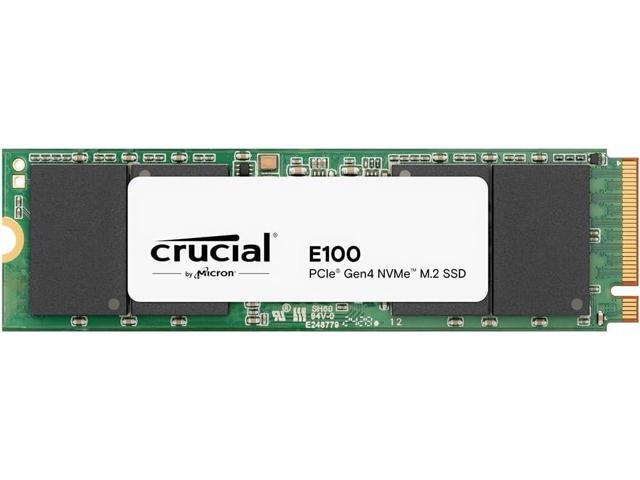
Crucial E100 2TB M.2 2280 NVMe PCI-Express 4.0 x4 PCIe Gen4 Internal SSD - Up to 5,000MB/s - CT2000E100SSD8
Micron 176-layer QLC NAND flash drive paired with a Phison E21T controller. Delivers snappy 5,000 MB/s burst reads and is one of the few budget NVMe lines offering a colossal 4TB model.
- NAND Flash: Micron 176-Layer 3D QLC
- Max Sequential: 5,000 MB/s Read / 4,200 MB/s Write
- Sustained Write Post-Cache: ~75–100 MB/s
- 1TB / 2TB Endurance: 220 TBW / 440 TBW
- Capacities: 500GB, 1TB, 2TB, 4TB
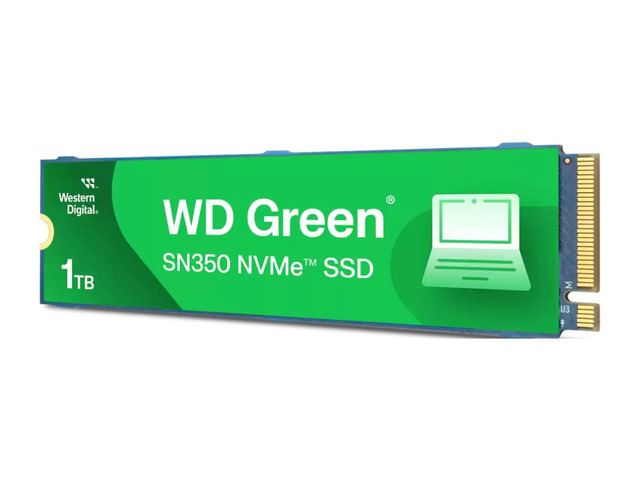
WD Green™ SN350 NVMe™ 1TB SSD - M.2 2280 Internal - PCI Express NVMe™ (PCI Express NVMe 3.0 x4) - 2400 MB/s Maximum Read Transfer Rate WDS100T2G0C-00CDH0
Kioxia/SanDisk 112-layer BiCS5 TLC NAND flash with Western Digital's custom in-house DRAM-less controller. Features nCache 4.0 hybrid caching and nearly 3x higher write endurance.
- NAND Flash: SanDisk/Kioxia 112-Layer 3D TLC
- Max Sequential: 4,150 MB/s Read / 4,150 MB/s Write
- Sustained Write Post-Cache: ~450–550 MB/s (5x–6x faster)
- 1TB / 2TB Endurance: 600 TBW / 900 TBW (Almost 3x P3 Plus)
- Capacities: 250GB, 500GB, 1TB, 2TB
The Verdict: Which Budget NVMe SSD Wins?
When comparing budget M.2 NVMe SSDs, on-paper burst benchmarks rarely tell the whole story. The Crucial P3 Plus appears superior at first glance with its higher 5,000 MB/s sequential read rating (versus 4,150 MB/s on the WD Blue SN580). However, the underlying NAND flash architecture makes the WD Blue SN580 the definitive overall winner for 90% of PC builders and laptop owners.
The critical difference boils down to TLC vs. QLC NAND:
- Buy the WD Blue SN580 for: Primary boot OS drives, general productivity, laptop upgrades, video editing, and heavy write tasks. Its BiCS5 TLC flash delivers 600 TBW endurance per 1TB (nearly 3x higher than Crucial's 220 TBW), exceptional low-power efficiency, and sustained direct-to-TLC write speeds of ~500 MB/s once the SLC cache is exhausted.
- Buy the Crucial P3 Plus for: High-capacity secondary game storage (especially the 4TB variant, which WD doesn't produce), read-heavy media libraries, or budget builds where every single dollar counts and the P3 Plus is discounted by $10–$15. Games are written once and read millions of times, meaning QLC write degradation rarely affects game loading times.
1. QLC vs. TLC: The Core Silicon Difference
The fundamental distinction between these two drives lies in how data is stored on their microscopic silicon memory cells:
Crucial P3 Plus: Micron 176-Layer QLC
Quad-Level Cell (QLC) stores 4 bits of data per electrical cell, requiring 16 discrete voltage levels. While QLC lowers manufacturing costs and allows Crucial to build massive 4TB drives cheaply, programming 16 distinct voltage states is inherently slower, generates more cell wear, and degrades write performance under sustained workloads.
WD Blue SN580: SanDisk/Kioxia 112-Layer TLC
Triple-Level Cell (TLC) stores 3 bits of data per cell with only 8 voltage states. TLC provides broader voltage thresholds, faster native programming times, significantly higher electrical endurance, and far superior stability when transferring tens or hundreds of gigabytes at once.
2. The Sustained Write Cliff: What Happens When Cache Fills
Both the Crucial P3 Plus and WD Blue SN580 are DRAM-less SSDs that rely on Host Memory Buffer (HMB) to borrow 64MB of host PC RAM for translation tables. To achieve fast burst write speeds, both drives treat a portion of their NAND as a fast Single-Level Cell (SLC) pseudo-cache.
However, when you transfer large files—such as a 120GB Call of Duty update, an uncompressed 4K video reel, or cloning a complete system drive—the difference between QLC and TLC becomes shocking:
- Crucial P3 Plus (Dynamic SLC Cache): Uses a massive dynamic SLC cache spanning up to 25% of free space. For short bursts (copying a 20GB movie), it writes at an impressive 4,200 MB/s. But once the SLC buffer fills, the controller must write directly to raw QLC cells while simultaneously folding previously cached data. Write speeds drop off a cliff to ~75–100 MB/s—slower than an old USB 3.0 thumb drive or a mechanical hard drive!
- WD Blue SN580 (Hybrid nCache 4.0): Uses a static + dynamic TLC SLC cache. In bursts, it writes at 4,150 MB/s. When the cache is completely exhausted, the drive falls back to direct-to-TLC writes at ~450–550 MB/s. That is 5x to 6x faster sustained write speed than the Crucial P3 Plus.
3. Endurance & Warranty: 600 TBW vs. 220 TBW
Terabytes Written (TBW) measures the total volume of data you can write to an SSD before the flash cells wear out. Both manufacturers back their drives with a 5-year limited warranty, but the TBW endurance ceiling is vastly different:
| Capacity | Crucial P3 Plus (QLC) | WD Blue SN580 (TLC) | Advantage |
|---|---|---|---|
| 500 GB | 110 TBW | 300 TBW | WD Blue (+172% more endurance) |
| 1 TB | 220 TBW | 600 TBW | WD Blue (+173% more endurance) |
| 2 TB | 440 TBW | 900 TBW | WD Blue (+104% more endurance) |
| 4 TB | 800 TBW | Not Available | Crucial P3 Plus exclusive |
For an operating system drive where Windows or macOS continuously writes log files, browser cache, page files, and app updates, 220 TBW on the 1TB Crucial P3 Plus can be depleted within 3–4 years of power-user usage. The 1TB SN580 at 600 TBW provides industrial-grade peace of mind.
4. Laptop Battery Life & Thermals: Single-Sided Efficiency
Both drives use standard single-sided M.2 2280 PCB layouts, meaning components are mounted strictly on top. This makes both SSDs physically compatible with ultra-thin laptops, ultrabooks, and mini-PCs without motherboard clearance issues.
- WD Blue SN580 Laptop Winner: Western Digital designs its controller in-house with ultra-aggressive PCIe low-power states (L1.2 idle draw under 3.5mW). In laptop battery longevity benchmarks, the SN580 consistently ranks near the top of the entire industry for watt-hours consumed per gigabyte transferred. It runs cool (~45°C–58°C under load) without needing a motherboard heatsink.
- Crucial P3 Plus Thermals: The Phison E21T controller is fabricated on TSMC 12nm and runs thermally modest (~50°C–62°C under load). While it is safe for laptops, its QLC programming cycles consume slightly more power during prolonged write sessions.
5. Game Storage & The 4TB Capacity Factor
Where does the Crucial P3 Plus stage an undeniable comeback? Capacity options and game library storage.
Western Digital only manufactures the WD Blue SN580 up to 2TB. If you have a single M.2 slot in a budget motherboard or want a secondary 4TB SSD dedicated to Steam, Epic, and Battle.net games, the Crucial P3 Plus 4TB is one of the most affordable 4TB Gen4 drives in existence (frequently going on sale between $209 and $239).
Because PC games write their files once during installation and thereafter only perform reads during gameplay and level loading, the P3 Plus's fast 5,000 MB/s sequential read speed and low QLC write endurance are not handicaps in a secondary game drive role. Games like Cyberpunk 2077, Baldur's Gate 3, and Starfield load in virtually identical times on both SSDs.
6. Can You Use Them in a PlayStation 5?
Sony officially recommends PCIe 4.0 SSDs with a sequential read speed of 5,500 MB/s or higher and a mandatory heatsink.
- Crucial P3 Plus in PS5: Benchmarks at ~4,400 MB/s on the PS5 format screen. The PS5 accepts the drive and boots games without game-crashing errors, though Sony displays a prompt noting performance may vary. An aftermarket heatsink ($8–$10 on Amazon) is required.
- WD Blue SN580 in PS5: Benchmarks at ~4,100 MB/s on the PS5 format screen. Like the P3 Plus, it can format and run PS5 titles, but heavy asset-streaming titles may experience minor pop-in.
Side-by-Side Specification Matrix
| Specification | Crucial P3 Plus | WD Blue SN580 |
|---|---|---|
| Interface & Bus | PCIe 4.0 x4, NVMe 1.4 | PCIe 4.0 x4, NVMe 1.4 |
| Form Factor & PCB | M.2 2280 (Single-Sided) | M.2 2280 (Single-Sided) |
| Controller | Phison PS5021-E21T (12nm TSMC) | SanDisk In-House Custom (DRAM-less) |
| DRAM Cache / HMB | DRAM-less (64MB Host Memory Buffer) | DRAM-less (64MB Host Memory Buffer) |
| NAND Flash Type | Micron 176-Layer 3D QLC | SanDisk/Kioxia 112-Layer 3D TLC |
| Peak Sequential Read | Up to 5,000 MB/s | Up to 4,150 MB/s |
| Peak Sequential Write | Up to 4,200 MB/s | Up to 4,150 MB/s |
| Sustained Write Post-Cache | ~75 – 100 MB/s (QLC cliff) | ~450 – 550 MB/s (Direct-to-TLC) |
| Random 4K IOPS (Read/Write) | 650K / 800K (2TB model) | 600K / 750K (2TB model) |
| Endurance (1TB Model) | 220 TBW | 600 TBW (+173% longer life) |
| Endurance (2TB Model) | 440 TBW | 900 TBW (+104% longer life) |
| Available Capacities | 500GB, 1TB, 2TB, 4TB | 250GB, 500GB, 1TB, 2TB |
| Laptop Efficiency (Active/Idle) | ~4.0W peak / ~30mW idle | ~3.5W peak / <3.5mW idle (L1.2) |
| PlayStation 5 Usability | Supported (~4,400 MB/s, needs heatsink) | Supported (~4,100 MB/s, needs heatsink) |
| Warranty | 5 Years (or TBW limit) | 5 Years (or TBW limit) |
| Typical 1TB Street Price | $59.99 – $69.99 | $64.99 – $74.99 |
🏆 Choose the WD Blue SN580 if:
- You need a reliable primary operating system drive for Windows or Linux.
- You want nearly 3x the write endurance (600 TBW per TB) for long-term health.
- You transfer large media files or video archives and need ~500 MB/s sustained write speeds.
- You are upgrading a laptop or ultrabook and want class-leading battery efficiency and cool thermals.
- The price difference between the two drives is under $10 (the TLC upgrade is worth far more).
🎮 Choose the Crucial P3 Plus if:
- You need a massive 4TB capacity drive at the lowest possible cost per gigabyte.
- You are installing it as a secondary dedicated PC game library drive (Steam, Epic, Xbox Game Pass).
- You prioritize burst read speeds (5,000 MB/s) for snappy daily application launch times.
- You find it discounted on sale for $15–$25 less than the SN580.
- Your workflow is overwhelmingly read-heavy and rarely writes hundreds of continuous gigabytes.
Frequently Asked Questions
Does the lack of DRAM cache make these drives slow?
No, not for everyday tasks and gaming. Both drives support NVMe Host Memory Buffer (HMB), which allocates 64MB of fast system RAM to store the drive's flash mapping tables. Unless you are running multi-user database servers or continuous heavy virtual machines, modern HMB DRAM-less SSDs deliver 98% of the perceived responsiveness of dedicated DRAM drives.
Will the Crucial P3 Plus slow down as it gets full?
Yes. Because the P3 Plus relies on a dynamic SLC cache allocated from free space, filling the drive past 80%–85% capacity significantly reduces the available cache size. Once full, any new write operations quickly trigger the direct-to-QLC slowdown (~75–100 MB/s). For the P3 Plus, keeping at least 15%–20% of the drive empty is strongly advised.
Can I install either SSD in a PCIe 3.0 motherboard?
Yes. Both drives are fully backwards-compatible with PCIe 3.0 M.2 slots. On a PCIe 3.0 bus, both drives will max out the interface limit at approximately 3,500 MB/s sequential read and write speeds.
More Verified Storage & SSD Deals Checked This Morning
Our pricing engine monitors live storage discounts continuously across Amazon, Best Buy, and Newegg. Here are other top values available today:
Compare All NVMe SSD & Storage Deals
Check real-time prices across Gen4 and Gen5 internal NVMe SSDs from Western Digital, Crucial, Samsung, and Kingston with verified price tracking.
Browse All Storage Deals→